Katharine Stancliff: based out of SC, Certified Saddle Fitter proudly representing Stübben North America servicing SC, NC, TN and GA. Catch me competing at local events with my buckskin Connemara cross Poppyfields Tristan, especially around the Tryon area.
Is there anything more exciting than a new horse? You have all the potential of that new partnership, all the dreams you hope to achieve, planning out your life together. Finding the best trainers, reading books, auditing clinics, trying to be the best horse owner you can be to give that new horse the best life. All blue skies and sunny days ahead.
Except, things don't always go as planned. That incredible new prospect gets a career ending injury, and you now have a gorgeous pasture ornament that's only 5 years old. The new horse doesn't really like your path in life, and would rather be a dressage/reining/endurance horse instead. You get hurt and can't compete for months of recovery or find yourself going in a different direction.
Or in my case, the most perfect young horse you could have ever hoped to own becomes violently sick and has to be put down before his 3rd birthday. Smashing your dreams into the dirt.
Unexpected.
Heartbreaking.
You try and do everything right. Routine vet care. Carefully choosing your nutritional program. Lots of grass and sunshine. Getting the chiropractor and massage therapists to help with the growth spurts. Engaging groundwork to keep his curious mind active. Good farriers to keep him balanced.
Tucker at 2 years
I really wrestled for weeks on how to move forward after losing Tucker. Maybe I made a mistake buying a young horse (3 weeks old when I finalized my purchase), after all there are a lot of things that can go horribly wrong early on. However, I came back to the same conclusion I'd had before I purchased Tucker in the first place; I will never be able to afford the type of horse I want if I wait until it's a 4 year old.
Tristan around the peak of his career
The goal with Tucker was to find a horse that would eventually fill Tristan's shoes. Tristan has been more than just a horse for me, he's been a life partner with whom I have achieved more in my riding career than I had ever expected or dreamed was possible. He helped me become a better, more confident rider and improved me not only as a horsewoman but as a person. Finding a horse to come behind him and help me continue on my journey has not been an easy prospect. I wanted a kind, thoughtful, sensitive, athletic horse with a great sense of self preservation. The Connemara crosses I've dealt with over the years have fit that profile incredibly well, with one small caveat. Most 15-16hh-ish Connemara crosses of riding age range from $15-40k, an amount of money I can never hope to have on hand in the reasonable future.
Enter Tucker, a young horse with incredible bloodlines. His dam is a large bodied 17hh Anglo Trakehner mare who consistently breeds award winning babies. His sire is an athletic and supremely well mannered Connemara stallion who passes on his level headedness to his progeny. The perfect combination.
Tucker around 3 months
Taking the plunge on Tucker was scary but incredibly exciting. Here was the exact horse I wanted at a price I could afford, all I needed to do was wait for him to grow up. There was a bit of worry when he first came home at around 10 months old for weather or not he would be easily handled. I'd worked at other farms before with wild babies, some even dangerous or intimidating as young as 2 years old. However, my fears were stomped down quickly with how well mannered and sweet Tucker was. For the first few days, I actually worried that he was ill because he was so quiet and amiable. Within the span of nearly 2 years with him at home, I can count the number of times he stepped out of line on one hand with fingers left over.
The first day Tucker came home to SC
I think that made losing him even harder. He made it so easy and fun to watch a baby grow into such a beautiful and kind young horse that the ending was even more tragic.
I remember a conversation I had with Beth (Tucker's breeder) just days after we lost him. "I just want him back, I want the same horse again."
Tucker just under 2 years
With an incredible stroke of luck, Tucker's mom was expected to foal in June and the newest breeding hadn't been spoken for yet. I immediately put my name on the list but the worry was if it was a filly, Beth had hoped to keep her and put her back into the breeding program. I was so desperate that I offered to buy a filly and lease her back to breed. I just wanted that baby so bad I was willing to do anything. We made plans to wait for Ella to foal out and go from there.
Thomas right after birth
May 31st I received a message from Beth that a colt had been born with Thomas' first baby picture (unnamed at the time). Not going to lie, I immediately started sobbing when I saw that first picture and kept crying for nearly an hour after. It was like all the pain, loss and eventual hope and joy poured out of me all at once. I was once again thrilled by the idea of starting over again with a young horse, and absolutely terrified of feeling that deep sense of loss again.
The problem with animals is, we know at some point in time we are going to lose them. Terrible, but unfortunately true. The only other possibility is us going first, but that's not important at the moment. All you can do is search your heart and decide if the pain of losing them is or isn't worth the time spent loving them.
So I took the plunge again. I bought another baby, this time we had signed paperwork only 12 days after Thomas' birth. It's scary all over again but all I've been able to learn from Tucker's death is that it came from a freak cause that will hopefully be highly unlikely to repeat itself.
Thomas at 1 month
I was incredibly lucky to be able to take time to drive down to Florida this past weekend and meet Thomas for the first time. He's still young and a little timid with people, but being able to lay my hands on him for the first time for a friendly scratch healed my heart in a way that was sorely needed.
Still scared, but looking forward to the future once again.
"Find the feeling you had at full gallop every now and then."
-Christian Kennedy-
I got back a couple days ago from completing my second Novice long format event with Tristan. The classic three day has been a goal of mine since I heard about them in college, and most of 2012 was spent trying to get qualifying scores to compete at a Training level long format at Hagyard in Kentucky. Unfortunately my single mindedness of that one goal during my stint as a working student at Renovatio with Eric Dierks ended up getting in my way, and I ended up with some of the worst showing experiences of my riding career regardless of getting the best instruction I'd ever been exposed to.
We had cross country refusals, time faults and rails in stadium, giraffe-like dressage test. You name it, I managed to mess it up. I remember running late for cross country warm up at one show, struggling to get my studs in on time, and slipping and punching Tristan's shoes on accident repeatedly. With blood dripping off my knuckles and trying to keep it from staining my white breeches, I leapt into the saddle and tore off for the cross country warm up. If I remember correctly, we finished that course with 60 penalties on course.
At one point, Eric and I sat down and talked about my goals as a rider and my direction for life. I was fresh out of college, not entirely sure where my career path was taking me besides the present. After telling him my goal was to qualify for a Training 3 day, he told me to think bigger. While we did eventually compete at Preliminary (something I never thought possible), looking back I don't really think he was asking me what level I wanted to compete. Eric has always been a "big picture" kind of instructor, like a riding coach and life guru rolled into one. Now 6 years later, I think I'm starting to understand.
Why do we compete? Why do we spend endless hours to sign up for expensive shows, take time away from work and family, all to win a 10 cent ribbon? Why do we risk embarrassment, pain, failure, and sometimes even our lives to achieve some arbitrary goals? If I'm not a professional rider and have no intention of going to the Olympics or competing at a 4 star level, what honestly is the point? I could just as easily stay home where it's safe, watch my horses graze out in the pasture and not bring that level of stress into my life.
The answer to those questions lies in two things; partnership and harmony. I've said time and time again that Tristan is my horse of a lifetime. He's taught me so much and brought me so far, helped me face my fears and risen up to every task I've given him. After building a partnership for 13 years together, I really have to think long and hard about how to use him and support him in an ethical manor. He is not some machine that I can replace parts on or throw out if no longer useful. He's a living breathing partner that has learned to trust me as much as I trust him. Especially as Tristan gets older, I need to think long and hard before asking him to do anything that could hurt him.
This past show at Southern Eights really felt like our harmony has cemented. Not saying we won't have off days, or that every second of every ride went smoothly, but I was finally in a frame of mind where I could ride accurately, supportively, and react to the horse underneath me. Taking the nerves and anxiety, pushing it aside and completing the task at hand. It's taken a long time to come to this point and it's a relief to have achieved that regardless of the score or points.
That's where showing helps me. It's an opportunity to set goals and practice with purpose, but more largely it's about challenging and cementing the partnership we've already built in the long hours at home.
These past months have really brought to light how temporary everything can be. Great moments of joy followed by deep moments of sadness. Being able to look down into the void and still scramble back out before it consumes everything. I'm sad from loss, but I'm also proud of the partnerships and friendships I've build both in and out of the saddle. I'm scared of losing another loved one, but I'm also excited about the future I still have to build.
Christian asked us to find the feeling at full gallop every now and then. I can tell you right now, I was there galloping around steeplechase on Saturday. Grinning ear to ear, wind in my face, and feeling that steady 4 beat rhythm underneath me as we flew down to the next jump. Fear mixed with joy. Pain with freedom. All in balance and harmony.
My first sighting of Christian was at Eric's course walk at Rolex 2012. I didn't know him then. My only focus was to listen as intently as possible to the commentary because I was trying to soak in everything I could learn from Eric through his clinics, videos, and teachings before moving down to North Carolina later that spring.
I remember being annoyed that this tall, gangly, blonde kid kept getting in front of me, easily keeping up with the course walk with his long legs and squeezing into all the good spots to hear Eric talk about each fence. Little did I know we would be living together shortly after.
Some people are just easy to be friends with. Christian's relaxed, humorous nature made it easy to like him. His passion as a horseman and talent as a rider made it easy to admire him. His caring, giving, hardworking attitude made it easy to rely on him.
All those things made it so much harder to lose him.
There was a memorial service tonight at Renovatio Farm where we lived together as working students for Eric and Trayce. It looks like there was a lovely candlelit service to remember and honor Christian's memory. I wish I could have been there and not working, but life keeps moving forward no matter how we feel.
I'm back here at Kentucky talking with lots of horse enthusiasts every day for my work. I wonder how many of them are as amazing and incredible of people as Christian was. I wonder how many of them have a whole army of family and friends rooting them on to succeed with their dreams.
I hope some of the young riders I meet will become the new generation of passionate, hardworking students. I hope they put their heart and soul into everything they do the way Christian did. I hope some of them have that infectious positivity where they light up a room just by being there.
It still hurts that you're gone.
I don't know if it ever won't.
I'll try to be grateful for the time we had, instead of sad about the time we lost. I'll keep trying to find that feeling at full gallop every now and then.
Live like Christian. Love like Christian. Ride for Christian.
I never thought that the next time I'd travel to see Christian would be to attend his funeral. I thought maybe I'd head down to Wellington someday to see what all the fuss was about, or catch him on a trip through Tryon for dinner and maybe play some cards. Sometimes things just don't work out that way though and it seems like the universe falls back into chaos.
The service was lovely and touching. The pastors found a way to capture the unfathomable loss, the palpable depth of love, the unfairness, the support we all felt being together, and maybe just a glimmer of hope.
"I found myself admiring Christian, which is odd for an adult to admire a teenager... When I grow up, I want to be like Christian," reflected his uncle.
"Find the feeling you had @ full gallop every now and then," quoted his friend Maggie from a note he left for her.
"I love you till my head pops off... and my arms, and my legs," said Anne, his mother. A saying they ended most conversations with since he was a small child.
I spent some time with Anne afterwards. Ever since hearing the news, I was gripped by a need to wrap my arms around her as tight as they could go and it felt good to do that. It's hard to find the words to say; we want to make it better, to say something to help heal the wound, but what words are there? I told her I could only imagine the pain she felt, only knowing my own feeling of loss. She responded no, grief affects all of us. There is no scale or measurement to gauge or compare.
To me, it seems that grief is a broken heart and for each of us it shatters into a different number of pieces. That initial punch in the gut, finding out what's happened, is the most profound. From that point on, we start gathering up the pieces one by one. The more we put together we start to move from that initial stage of loss, to remembering the person, remembering the good and the bad. Eventually we may even put that heart back together again. It might take weeks, months, years, decades, lifetimes, but every little piece we gather up makes us feel a little more whole again. It might be a memory, hearing their voice, seeing a rainbow, thinking of a joke, singing with a favorite song, but each moment and small smile adds up over time.
There was quite a bit of karaoke and dancing, revelry, snowman building, and s'mores making after the service. I think Christian would have approved. Joy amidst grief. Strength with the pain. Smiles between tears. I don't think we could ever forget that force of positivity, no matter how many years go by.
Thanks for the smiles, thanks for the joy, thanks for being you and inspiring us to work harder. You may be lost, but will never be forgotten.
It's been over a week now that we heard the horrible news of your accident. People talk about the stages of grief, but they seem to all happen simultaneously. Immediately I felt shock and disbelief, like it was some sort of sick joke and after a couple days you'd call or text or post online, "haha just kidding." It's not a joke though, you're really gone. From shock came oppressive grief, the feeling like you'd either been punched in the gut or just had some sort of empty hole inside of you. I constantly felt hungry, with no appetite, no desire to enjoy food or anything I was doing. My face hurt from crying into my ever-present windburn, and every time I thought I was out of tears for you more would follow. Now I'm finally getting to the point where I can say your name without crying, remembering the good times, remembering the amazing person you were, and what a light you were in all of our lives.
Because crying feels disingenuous to your memory. You were such a positive, happy guy, I know you'd be upset to know how many people you made sad. You were always quick with a joke, quick with a smile, quick to lend a hand, always ready to go the extra mile. Your passion for horses is what made me love you first. Lots of guys are afraid to show affection, especially to animals. You had no shame and I can't count the number of times I would walk past a stall to see you taking an extra moment to give a horse a scratch or cuddle.
That passion was leading you to great places. There's absolutely no doubt in my mind that we would have seen you riding in the Olympics some future year. Not only were you so passionate about your horses, but your pure talent and drive always blew me away. The gangly 15 year old forgetful kid was really blossoming into a bright young man. I can only imagine what your mother felt, but I know it was hard for me to watch you growing up, when in my mind you felt more like a kid brother. Now the knowledge of all the things you won't experience sits in our guts like a hard stone.
As an outgoing, happy person, surrounded but other outgoing, happy people in Wellington, you started to enjoy the area and going out with friends pretty quickly. It worried me on occasion that you might get drawn into less than savory groups but I chalked it up to youth and happiness and didn't want to rain on your parade. I wonder know if I should have said something, but it's really hard to give 21 year olds meaningful advice especially when we all feel like we have life worked out at that point.
I really felt mad with you for awhile. How could you be so stupid to not wear a seat belt*, to be in a car driving so fast? Why didn't you make better decisions that night? All I had to do is think back on mistakes I made in my life.We can all look back and find at least a few moments where we made a snap judgement that could have ended very badly, but somehow skipped out with little to no damage. When I was in college, I tried to lead a 3 year old OTTB from his stall a couple feet to our indoor arena for turnout when he blasted out of the stall like a start gate on the track. I was dragged about 20 feet hanging onto the halter before my brain clicked on to let go, and went face down into the dirt. He ran past me and luckily didn't kick out, because I ended up being alone in that barn for the next 6 hours. If I had been injured I very well could have died that day, all because I wanted to save 2 seconds of attaching a lead rope.
I mean to say that none of us are blameless, usually we have a moment like that and look back years later thinking "man, that was dumb. I could have really gotten hurt." You don't get that second chance, and I think that's what seems the most unfair. I know that if you had any inkling of what would transpire that night, you would have done things very differently.
In the days after the accident, I was so grief stricken it was impossible to see any kind of silver lining over such a senseless, preventable death. What struck me though was the outpouring of love, of donations, of stories online from all the people who's lives you touched. It seemed everybody who met you, even if just for a day, remembered you and remembered your unique and shining personality. We always ask kids what they want to be when they grow up, but I think the better question is what kind of legacy do you want to leave behind? Do you want to change the world for the better, raise a family, make lots of money, travel the world?
The legacy you leave behind is your memory and how you've touched the lives of so many even though you died so young. The legacy you leave is the Christian Kennedy Future Stars program that Robert Dover was so kind to name in your honor. The legacy you leave is in the smiles of your family, who despite suffering such a horrific loss seem to be able to remember that shining positivity we so loved you for.
It's still a long road ahead of sadness, and we will always and forever miss your presence. I'm trying to not get lost in grief like I did the first few days. I'm not religious, so it's hard not knowing what's happened to you now. To me, you're just gone. However, I do find myself talking to you in my head, repeating the same three statements over and over.
I love you.
I miss you.
I wish you were here.
***Addendum***
It has come to my attention that the news stories mis-reported that Christian wasn't wearing a seat belt. He was, so he did try to make a decision to stay safer but the speed of the vehicle was too great for it to protect him. It doesn't make the outcome any better, but it just drives home the point that he was a good kid and struck by an unfortunate accident.
*This post is part of a 4 part series on basic principles of saddle fit. Please be aware that there are many other factors often present in saddle fitting for both rider and horse, and it is best to contact a professional to make sure your horse is fitted properly and all factors are taken into consideration. These posts are meant to help the reader develop a basic understanding of saddle fit, and to be able to recognize a situation where a professional saddle fitter needs to be called in. Enjoy!*
Saddle Fit Basics in Four Parts - Spinal Clearance
There are many factors to be taken into consideration regarding proper saddle fit for the horse. I've narrowed down the broad picture into four basic starting points for evaluating proper fit, and beginning to identify issues. We'll begin with Spinal Clearance.
To many it will be obvious that the saddle can not make contact with the horse's spine, especially the wither. A saddle sitting directly on the spinal column (remember these are bony structures) will cause the horse to be very painful and sore and he may refuse to work or act out with bucking/rearing/bolting as a result of this pain. However, once we have clearance what would "adequate clearance" entail?
I've heard lots of rules of thumb in the past, whether it be 2 fingers, 4 fingers clearance over the wither. Others say, just as long as it's not touching you're fine. What's important to consider is if you evaluate your spinal clearance in the aisle with the horse standing statically, you don't have the added factors like a properly tightened girth, the weight of the rider, or the movement/lift of the horses back to consider. Thus the best way to evaluate will be with a rider mounted and the horse in motion.
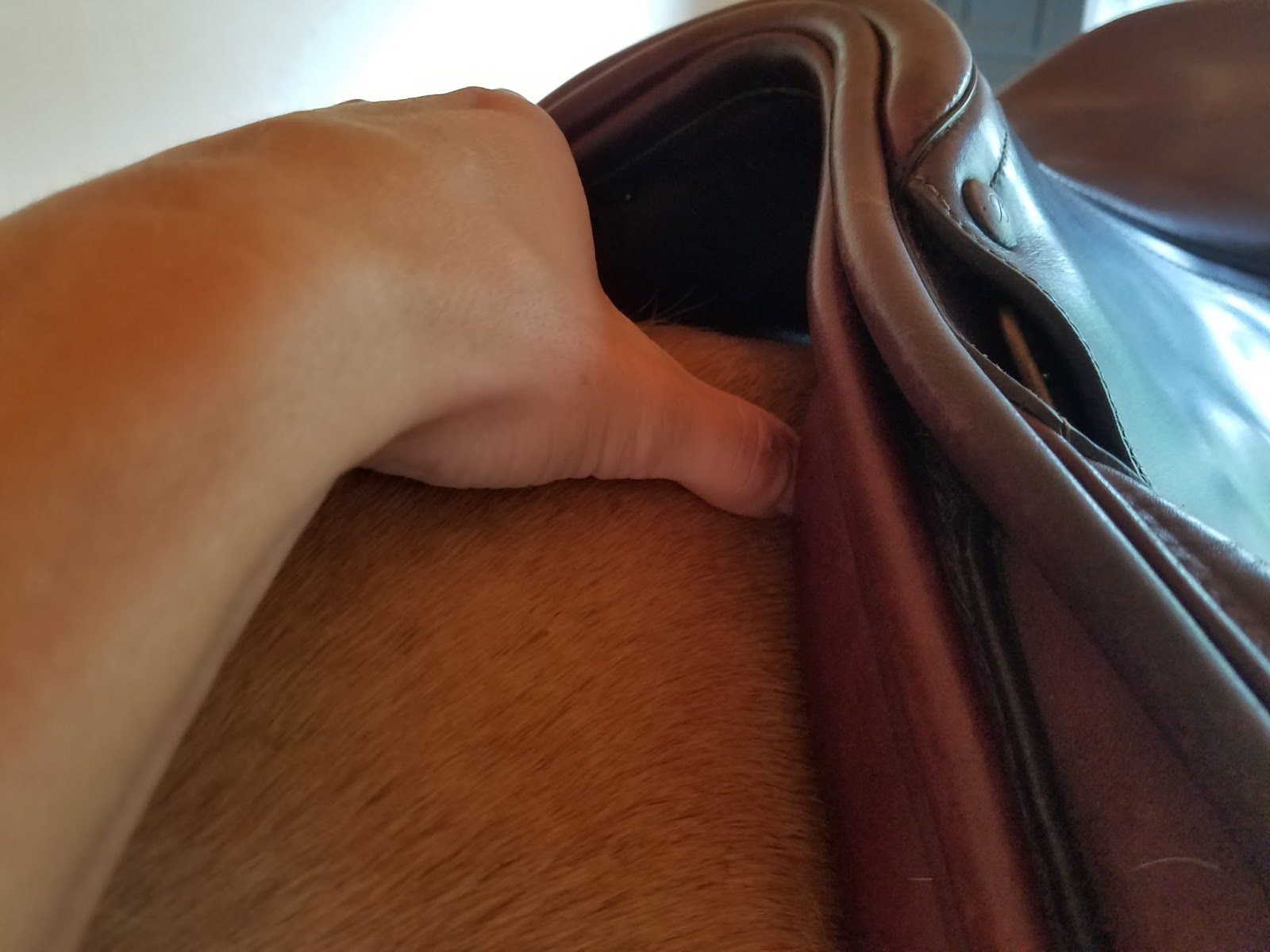
To get a general base, I do start in the aisle preferably with no pad and the saddle girthed down. What I'm looking for is room to get my hand down the gullet to the base of the wither (assuming the saddle is placed properly with the tree points either directly behind the scapula for a Stübben, or slightly further back for other models, depending on the manufacturer) which is especially important for a horse with a very long wither. We don't want to have clearance at the pommel and then make contact halfway down the gullet since this will still make the horse sore.
In addition to having clearance over the top of the wither, I also want to make sure I have some room on either side as well. It's difficult to see in the picture above, but I can put two fingers on either side of the wither with room before the panel makes contact (I would call that adequate). What people often forget is that the spinal cord and wither is very mobile in the horse and needs to be allowed to move freely side-to-side. If the saddle is too tight on either side, it will restrict the horse's movement and may appear lame or just unwilling to move out and forward.
Notice, I specifically haven't mentioned an exact measurement over the top of the wither for proper clearance. That is because the necessary amount of clearance will vary from horse to horse. In general, I would like to have at least 3-4 fingers clearance over the top of the wither with the saddle girthed and rider mounted to account for the horse's movement, compression of the flocking, and other factors depending on the individual case. However, if I'm dealing with a downhill or mutton withered horse, the amount of clearance may be higher to allow proper balance of the saddle from pommel to cantle. It may look funny to have a lot of room but we'll talk more about how important the balance of the saddle can be on those horses. Essentially if all the other factors are adequate, you really can't have TOO much clearance, but you definitely can be too close to the spine.
This picture above would be a prime example of a saddle with proper clearance above (I have room for roughly 4 fingers), but not at the sides of the wither (I can't even get one finger next to the side of the wither). I would expect this horse to be restricted in his movements. He may not present as totally sore, but may be less willing to move forward and work than he would in another saddle.
These two pictures show a horse with a fairly high wither. Over the top of the wither I can get about 3.5 fingers and on either side about 2 fingers clearance. This looks fairly good, but with the addition of the rider's weight, I would recheck and see if we need more.
These pictures show a client of mine who is built very downhill and completely mutton withered. I have lots of clearance in the pommel (as shown by my fist) because I'm trying to achieve proper balance from pommel to cantle as shown in the pictures on the right (proper balance in this dressage saddle should be roughly a 1" drop from cantle to pommel on this saddle, which I'll discuss with more depth in an upcoming post on Balance).
U shaped tree
V shaped tree
Excuse the poor artwork but the pictures above are a rough illustration of two common types of tree shapes shown as a cross section of the horse's wither with the head plate/gullet plate shown on top. The V shaped tree on the left is the most common shape you'll find in a saddle, while it can fit just fine on the shown horse's cross section we are a bit snug on either side of the wither and do not have even contact through the point. In this situation, it may be necessary to go wider with the tree size and add extra padding or a half pad to offer proper clearance, just to allow freedom of movement.
On the right, I show a rough drawing of the shape of a Stübben tree. You can see that there is more room on the sides of the wither (still keeping clearance over the top) and the tree points are making more even contact with the horse's side for better bearing surface of the tree. In general I prefer this method of fit, though some horses can work fine in V shape tree I tend to find better comfort and results in a U shape instead.
To recap: we don't want the saddle coming into contact with the horse's spine especially on the top and sides of the wither. Adequate clearance may vary from horse to horse depending on his build, but should be reevaluated with the saddle girthed down and rider mounted to ensure proper clearance. When in doubt, call a certified saddle fitter to help evaluate your horse and take other factors into consideration.
Coming soon, Tree Width, Balance/Stability, Bearing Surface, and other notes!
I'd like to share some thoughts about a very dear friend of mine that I cherish greatly, and after his accident last week I've really spent some time thinking about how much he's impacted my life. I first met Eric Dierks at a clinic in Ohio while I was in college. I remember being very nervous for my lesson with him (I'd heard so much about him through the grapevine in Illinois and ridden with nearly every family member of his back home, but never Eric before) and it amazed me at how well organized his thought process was within his training mantra. He broke down his system into bite sized pieces we could all understand, take home, and practice on our own. We spent much of that lesson focusing on the rhythm of the walk, something I'd never really given much thought before and I went back and practiced for months until Eric's next clinic hoping to impress him.
By the second trip he made out, I was absolutely hooked. I spent every moment of the clinics by his side drinking in every word he said and watching all the riders and horses progress in the partnerships under his tutelage. He's always been well spoken, firm but fair, and always on the horse's side to improve the rider's communication. When the third clinic rolled around, I nearly begged Eric to take me on as a working student. He agreed.
During my time as a working student
As soon as I graduated college, I drove back to Illinois to pack up nearly all my belongings into trailer and SUV and made the trek down to North Carolina with my mom to help me get settled. I ended up working at Renovatio Farm with Eric for 7 months and he truly changed my life. Not only did I find the perfect geographic location for me to settle down and make my home like the Chicago suburbs had never felt to me, but I had found someone who could really shape me as a horsewoman.
It wasn't easy. Being a working student means working hours well past sun up to sun down, night checks, pitching in on your days off, catching horses in that random 3 am thunderstorm and sometimes finishing a day where cereal was all you could eat because the idea of standing up to cook was exhausting. Eric took me apart to my basic essentials as a rider and started over, building me back up piece by piece. Am I a upper level professional now? No, but I never expected to be, with a pony cross I was told "couldn't jump" and my own fears and insecurities. What I have become is a much more compassionate rider, able to listen to what my horse is telling me and react in more appropriate ways.
I went from an ok Training level rider, to having some pretty crummy shows at Training level, to leaving Eric's farm to get a real job and having time to let all my education from him sink in and get fully absorbed, to winning our next Training level the following show season on our dressage score (our very first double clear) and eventually completing a Prelim event which I had never even dreamed possible. Eric pushed me to believe in myself, to believe in my horse, and to be able to rely on my own instincts as a rider.
I only have the budget to go lesson with Eric a handful of times a year now, and I try to squeeze every last drop of education I can out of every visit. We had the good fortune of riding with him the day before his water heater explosion accident, and once again he expertly coached Tristan and I around XC schooling at Windridge farm. The weather was perfect, Tristan jumped everything we put in front of him and we all just had a marvelous time together enjoying our four legged friends.
Eric, you have been a life-changing force to me and I can never repay you for how well you shaped me into a fairly respectable horsewoman. I hope you are teaching me lessons until you're at least 120 years old and then you might be able to think about retiring, but definitely not before then. If you really need a vacation, next time just ask, the airlift was a bit overkill. You have the whole equine community of Tryon and beyond rallying for your swift and full recovery. Thank you for all you've done, and I know you've touched many lives beyond mine too.
Boots; the classic equestrian footwear. I remember as a kid taking lessons, I had a number of sturdy rubber dress boots that I rode in every week. They were hot in the summer and cold in the winter, wore out quickly, had very little support, but you could stomp around in puddles and mud up to your knees and keep your feet dry. I definitely wasn't winning any fashion contests wearing them, but especially as a kid going through growth spurts they were an excellent choice.
Just like these!
Now as the eventing world has embraced the Dubarry fashion trend (mimicked by nearly every boot company worth their salt), riders can have stylish and more supportive footwear while still keeping their feet dry! Which is great! Unless...
Unless you have oddly proportioned legs and ankles. I have been cursed blessed with very narrow ankles and calves, paired with larger and very flat feet. As a teenager, we discovered the main reason I had terrible shin splints and leg pain was due to my feet containing extra bones, which aren't very helpful and throw everything out of wack dooming me to wear orthotics and supportive footwear for the rest of my life. (No wearing high heels long term for this non-fashionista)
Enter the Dubarry "Galway" boot
But then Dubarry gained popularity and I got starry eyed at their display during Rolex several years ago. I pined and pined over their boots, but they were always too wide when I tried them on (ankle and calf). I dreamed about being able to walk my cross country courses in the dry comfort of leather boots (including the water complexes). Previously I would have to decide on either a) being comfortable and wearing tennis shoes or b) being hot and sore wearing rubber muck boots that could brave the water. Lucky me, Dubarry eventually released their "Clare" style, which was a tad narrower in the calf and ankle than their original boot!
The Clare!
I managed to snag myself a pair and after a brief break-in period, I was in love. I would wear theses with shorts, dress up and wear them out to dinner, they were perfect barn work boots, and I took better care of them than I would of a child! (It's true) Unfortunately after having them for several months, I noticed something strange when walking through water with them. While they were still keeping my feet dry, the GoreTex liner seemed to be separating within the toe from the leather outer shell giving me the feeling of a bubble of water forming over my feet. I'd had some friends with less than savory experiences with Dubarry's customer service, but as soon as I contacted them with my issue they quickly and easily replaced my boots with a new pair! But... after having those for a few weeks, I discovered that there was an area that was stitched improperly and was coming undone. I met with a Dubarry rep at a trade show and again, their excellent customer service took care of me and replaced my boots yet again!
Which brings me to the current pair I own. They're waterproof, they're beautiful, but something is just different from the previous boots I've owned. Both the other pairs I've had, after a short break in period fit like a second skin. The newest pair I have (which I've babied) never fit quite like the previous pairs. The right boot especially allows my heel to pop up and down, causing nasty blisters. After a lengthy period of time hoping for the fit to improve, I've finally come to the conclusion that they just don't fit my skinny little ankles.
Now I'm aware that Dubarry has newly released a "narrow" version of the Galway boot, but comparing the with of the ankle to the original, I'm 99% certain it's only really narrower in the calf. "But Katharine, there are loads of other brands with similarly designed waterproof leather boots!" Which is great, except they all have a wide ankle.
This has lead me to continue my search outside of the equestrian shopping experience! I was very hopeful when I first started, but as this has dragged on for several weeks, I find myself thoroughly disappointed. Truly "waterproof" boots for women are few and far between, unless you can comfortably fit in a rubber boot (which I can't due to the wide ankles). Here's the closest options my search turned up.
I know, I know, they're pretty gaudy and out there with the camo and the name, but as far as something to fit snugly through the ankle and calf I was pleasantly surprised how comfortable these were! Plus they have Cabela's version of GoreTex called "4MostDryPlus" and since they're meant for hunting (and protecting the wearer from snakebites which is a plus) they feel very sturdy. The downsides were the thick insulation, which I can't imagine being comfortable walking courses in 90+ degree weather, and the sizing runs a bit small so I wasn't able to try the correct size in the store. For almost $200 I definitely wanted to give them a thorough test.
These boots from Merrell caught my eye. They have a similar look to "equestrian" styled boots, boast a waterproof membrane, and the biggest complaint on product reviews were that the ankle and calf were too narrow! My biggest holdup is that the inside has a full length zipper, so how can they possibly be waterproof? I called Merrell HQ and asked their product division just that, and the answer I got is that they will "stand behind their product". I was also able to find them on Nordstrom Rack's website for $105, less than half of their list price with a great return policy if they don't work out. I took the plunge today and ordered them!
I tried several other styles of rubber boots too since North Face had one that looked narrower in the ankle, but alas everything I tried was still too wide. I hope my search has come to an end with Merrell, but I'll have to wait and see when they come in. In the meantime, my beloved Dubarry Clare's are going to make their way onto EBay to hopefully sway the cost of new boots. I'm very disappointed that they can't work out for me. Ah well, first world problems.
When I was a kid, people would suggest I turn my love of horses to a veterinarian profession and I shied away from the thought. Not only did the idea of gore, needles, sticking your arms up various bits of the horses, turn me off, but there was always the calls to put horses down that made me know that a career path in medicine definitely wasn't for me. So instead, I opted for happier work like boarding, training, retail, and saddle fitting, thinking I'd be safer from grief except for my own horses.
Getting a bachelor's degree helped prepare me for my career path and opened my eyes to new facets of equine care; farm design being less about aesthetics and more about ventilation, drainage, and safety. Planning schedules for veterinary and farrier appointments, maintaining pastures, fencing, arenas, proper electrical considerations to protect against barn fires, all in the name of the safety and health of horses under our care. We learned how to recognize and treat illness and injury in horses, how to identify various lamenesses, and properly condition to prepare for competition. All in the name of safety.
But life doesn't always follow the rules. Even if you offer the best care, top of the line service, and your client's horses thrive under your care, tragedy can and will still strike.
Nothing we learned in school prepared me for the moment I saw that my best friend's horse had sustained a life ending injury in a freak accident. Nothing prepared me for the panicked phone calls to local vets to get help as quickly as possible. Nothing prepared me for telling my friend her horse had passed before she could see him. Nothing prepared me for the grief over a horse that was never mine, but had still managed to leave a huge impression on my heart.
But life goes on. The rest of the farm still needs care, the other horses need to be fed, stalls need to be cleaned. Seeing the other horses seeming to process the loss was the hardest. My horse Tristan was most closely attached to the horse we lost, and he never once called out to him. I caught Tristan gazing from his stall at the spot where he passed, but not a single whinny.
We take solace in the things we can. The injury was dealt with immediately, he wasn't in pain for long. Nothing could have been done to foresee the accident. We are lucky to have the support of wonderful friends and family that have offered love and shoulders to lean on. I will always live with some small amount of guilt. What if I had caught them to feed five minutes sooner? Would it have never happened? Would it have still happened but in the middle of the night under worse circumstances? We'll never know, but I've been over and over it in my head enough to know I did everything I knew to protect him. It just wasn't enough this time.
Appreciate every moment with your horses. For being such strong and graceful animals, they are so very precious and fragile.
We will be ok eventually, things will go back to normal. Life goes on. For now, there will still be some grief.
Rest in peace, Bear. Once by our side, but forever in our hearts.
The three amigos from this summer: Bear, Paco, and Tristan
Earlier this year I wrote a blog discussing the concept of "rhythm"
and its importance during all three phases. (Available here - http://thoughtsofpoppyfields.blogspot.com/2015/01/becoming-infatuated-with-rhythm.html)
Becoming infatuated with my horse's rhythm in all 4 gaits has been a
major goal of mine over the past 8 months, but I can honestly say we
finally had a "Eureka" moment about the concept very recently. We were
guided to that understanding over not one, but two days of schooling
cross country with my trainer, Eric Dierks.
Day One - Windridge Farm
I'd
had a jumping lesson with Eric about two weeks prior, but was feeling
pretty rusty after our hiatus from showing this summer. (Last show was
in April! Yeesh!) We planned to meet at Windridge for their schooling
day, but decided to skip the show on Sunday remembering last year's debacle.
Managing to be the first horse and rider on course we had a wonderfully
private warm up. Starting out, we tested out the trot, canter, and
gallop, focusing on that all-important concept of rhythm. Eric said, "Taking straightness as a given, we have to focus on the horse's tempo, length of stride, and cadence to produce rhythm."
"Taking
straightness as a given" was an important place to start. I found as we
did some warm up gallop sets up and down the hills on course that the straighter I rode Tristan's body, (occasionally suppling him through
the withers with my thighs) the more energetic and powerful his gallop
felt, regardless of the mpm we were traveling. Another great term that
Eric used for that feeling of power was thinking of it as your RPMs
coming into the jump.
For a warm up, we worked over
small, beginner novice and novice fences at a trot and after we had
rhythm and energy at the trot, we moved on to novice, training and
prelim fences keeping the same concept at the gallop. This idea produced
better energy, more scope, and (here's the big one for me) a more
predictable take-off spot. Eric has discouraged me from counting strides
because he knows my obsessive brain would focus on that, and only that,
coming into the jumps. Focusing on rhythm (remember; length of
stride + tempo + cadence = rhythm) helped me be a more active rider in
between jumps and less dictative of Tristan's take off point (because
honestly, after 9 years he should start seeing those for himself).
As
the schooling progressed, I felt more confident of my distances,
regardless of the size of the jumps. Plus, if I did some counterbending
to the outside of turns, I could improve my straightness and, more
importantly, the energy and rhythm coming to the jump. I only had 2
jumps the entire lesson where I "missed"; once over a trakehner in the
woods where I lost my focus and intent to the other side of the fence,
and once over the prelim water complex where I got too anxious about the
bank up to look for my out over the 3rd jump of the combination. Both
errors were easily fixed the second go around.
Day Two - Gibbes Farm
Feeling
pretty big for our britches and finally "getting" the idea of rhythm,
Tristan and I came into our clinic group fairly cocky, if a bit
sore from the previous day's school. I seemed like we struggled with
applying the concept a bit more the second day than the first, but it
was good to practice over a a wider variety of jumps and situations.
After
we warmed up with the same exercises, trotting and then
cantering small fences with the same feel of rhythm, we started
challenging that rhythm with the introduction of hills and related
lines. The pictures below are a good example of the challenges that came
up. Eric put together a small course of a hanging long to a five
stride combination (table to skinny), then a hanging log with a huge
groundline (or baby weldon's wall) to a 2 or 3 stride combination
(depending on your length of stride; we were instructed to not dictate
the distance, just ride the rhythm). First time through this course, I
had an oops moment that sent me off course.
Fence #1
Fence #2 Table at the start of the 5 stride line
Fence #3 Skinny out (aka Oops)
First
time into the combination, we had a great big leap in (not pictured) and
I slipped my reins over the fence so I wouldn't catch Tristan in the
mouth on the back side. 5 strides isn't a lot of time to get your reins
back, so I only managed to get my left rein before the skinny, thus the
awkward jump out. I took a bit too much contact on the right rein by
bringing my elbow back, and continued to try and organize after the
fence, causing me to miss jump #4 on our course completely. What's the
one word I didn't use to describe that attempt? Oh, right. Rhythm.
I got so drawn into "seeing a distance" to the table coming in that I
completely went into neutral and stopped riding Tristan's rhythm to
each jump, and then lost focus on my line to jump #4 and went off
course. After a breather and watching my comrades jump through the same
course, we gave it another go with much better results.
Fence #3 again
Fence #4
Much
prettier picture this time around. Focusing on rhythm gave us a better
distance and line to the following fences. After popping over the hanging log
up the hill and pointing towards the downhill 3 stride line, I was
able to feel the rhythm, support to the base of the first log, and keep
the RPMs revved to make the 3 strides work without depleting our gas
tank and running at the second fence. The ability to see what needs to
happen to the strides before and between jumps is something I've never
been able to feel and accurately accomplish so I'm very proud of that
little lightbulb moment.
After some successful coursework,
we moved on to banks and water. Both those words give me more anxiety
than I'd care to admit, but with the building blocks of rhythm and
balance it was much easier to gauge whether I was coming to an up or
down bank with an appropriate canter and, if not, what adjustments
needed to be made to rectify the situation. We ended with some pretty
nerve wracking water combinations, (a log, two strides to a three foot
drop, gallop through the water to a three foot bank out) but as long as
we stayed focused on rhythm instead of getting drawn into the anxiety of
the more difficult jumps, everything went smoothly. I was happy to hear
from my husband (the genius behind the camera on all these amazing
pictures) that Eric commented that my position over the banks has
improved dramatically and was almost perfectly where he wanted me to be.
I've gone from being scared sh*tless over banks and water to logically
thinking through any combination we are pointed towards.
Nice log before dropping into the water.
Jumps in the water present a challenge to maintain energy and rhythm along your track.
The
biggest takeaway I had from schooling, and a general theme to Eric's
teaching style, is that the more you can focus on having correct basics
and a tactful frame of mind, the more you can handle every situation in front of
you with calm and logic. To achieve rhythm we first need to be sure the
rider is in an effective position, has a proper engine and power,
and finally a prepared track (which also includes straightness). Put
that formula together and you can achieve a balanced picture over any
fence and achieve that cool competitor look that riders like Michael
Jung and William Fox-Pitt portray so well. Instead of obsessing over the
little anxieties, become infatuated with rhythm.
My first love is and always will be eventing. Nothing gets me going like executing a harmonious dressage test, followed by a bad-ass cross country ride, and polished off with a graceful stadium round. However, recent budget restraints have helped me start to think out of the eventing box to get my thrills and give me goals for exercising and training my horse. We started with Hunter Paces this spring; lucky for me, moving to South Carolina has opened up a great big world of paces I never even knew existed, thanks to the urging of our horsey neighbors and the Western Carolina Hunter Pace circuit. Hunter Paces are fun, casual, usually fairly bite-sized distance rides over varied terrain and trails. If you're preparing an event horse for show seasons, I highly recommend them as an excuse to get out in the open and just ride.
Recently, I attended a pace at the FENCE showgrounds, and as part of the course, we were directed to ride on some short sections of their steeplechase track. The foxhunters riding with me were willing to go at a good clip of gallop, so we had our own little mock race between the four of us. Tristan immediately went into racehorse mode (weird for a 15.3 hh pony cross who's never seen a racetrack in his life) and got super competitive with our buddies. Not crazy, definitely rideable, and a whole lot of fun.
Shortly after those little escapades, I found several posts online from the Blockhouse Steeplechase that an amateur race was open to the public for horses and ponies alike. This was just a flat race, no fences to worry about, and especially with a money purse, (not required to peak my interest, but winning is extra super fun when there's a check involved) what did we have to lose by giving it a shot? At $50 an entry, it was a lot easier to chew than a $250 show bill for an event (not counting food, hotels, travel, etc.).
Ermahgerd. Gergles.
We attended several rider meetings to go over the requirements of our tack (I did have to go out and buy a racing overgirth to keep my saddle firmly in place, plus jockey goggles to help protect my eyes), how to properly condition our horses, and even got to walk the track with a retired steeplechase jockey to help ensure our safety. The group we had pulled together for the race included a husband and wife barrel racing team (veterans to the amateur racing scene with 5-6 starts for each of them in previous years), a trail rider looking for some fun, and a fellow english show rider.
When race day arrived, a hurdle I never anticipated became quite apparent. They had told us at the rider's meetings, that we absolutely needed to have at least on person at our stalls at all times during the race day. The reason, we soon discovered, was not to keep an eye on the horses, but to keep an eye on the many, MANY spectators in attendance. I swear we saw several hundred people visiting our stalls, wanting to pet the horses and take pictures with them. From small children to the quite elderly, a love of horses was in the air. Many people looked like they'd never interacted with a horse so up close and personal before, while some would ask about breeds and what disciplines we rode in. If just one little kid left today with a newfound love of horses and the equestrian lifestyle, I believe our work in inspiring a new generation of horsemen and women was fulfilled. Tristan not only tolerated all the affection, he simply hammed it up between naps and peppermints to reward him for his exceptional behavior. He gently allowed the smallest children to leave him with a nice pat on the nose, and inquisitively peered into the many alcoholic beverages paraded past him by the adults. I was filled with pride by his super attitude all day.
The time finally came to head to the start, so we promptly tacked up and headed to "the paddock" to be instructed when to mount, warm up, and line up for the race. After waiting all day, the moment had finally arrived to see if a Connemara/Trakehner cross could be a legitimate racehorse. And they're off!
We may not have won, we may not have come close to winning, but I learned some new things about Tristan during this fun race! Firstly, when four horses start galloping at full speed right next to us, Superpony gets downright competitive! My original plan was to have an easy gallop on the first uphill, let him stretch out on the down, go easy around the turn at the bottom, then let it loose on the homestretch. That plan went out the window the second the flag went down. The closest parallel I can draw is to imagine sitting on a lit rocket, with minimal steering, absolutely ZERO brakes, and no seatbelt. Plus, you're loving every second of it as soon as you get over the sheer speed you're traveling at. I honestly didn't know we had that gear!
Whee! Go Pony, go!
It was a bit disappointing to not stay with the big kids in the race, but we came out to have fun and try something new and that's exactly what we accomplished. The bottom turn came up quickly and was quite sharp, so I preferred to use the little brakes I had to ease up around the turn and come home safe, rather than run at breakneck speed and risk falling or hurting Tristan. So we gave up our fourth place position by playing it safe. Plus we got to enjoy the last haul to the finish line with the crowd screaming "COME ON NUMBER 3! YOU CAN DO IT NUMBER 3!" We crossed the finish line dead last, but I had a huge smile on my face and Tristan was ready to do another lap. (I swear, if we had another two laps on the course, we would have out-enduranced the whole lot of them!)
Still fresh and perky post- race - Photo courtesy of Eric Dierks
An exciting event like this truly isn't possible without the help from all the wonderful volunteers. We were graced by the presence of the divine Annie Lane-Maunder, a fellow event rider and amazing equestrienne, who helped us all tremendously throughout the day and got us all to the start in an orderly manner. Many volunteers were posted to man the gates and keep horses, jockeys and spectators safe, and facilitate a fun and action packed day at the races.
It's very easy to stay in your box, ride in just your favorite discipline, well within your comfort zone. What I love most about event horses and riders, is we create an athletic partnership based upon versatility. It's not enough to have excellent weightlifting and body building in dressage, or to just be a daringly bold jumper in cross country, and a agile show jumper. You need to cram all those talents into one horse and rider and accomplish these incredible feats back to back in a stressful, judged environment surrounded by your peers. Thus, we are a scrappy group of athletes capable of a great many things. Step outside your comfort zone, do a pure dressage show against the DQs. Try some distance riding to work on your endurance and your horse's partnership with you. Ride in a race and feel what it's like to go at a flat out gallop. Heck, go ride western once in a while and work some cows if it suits you. Gather those experiences and apply them back to your preferred discipline.
Tristan's going to enjoy a couple days off to munch on a good bit of pasture while I narrow down our next challenge, whatever it may be. Until next time.