Monday, April 13, 2015

Focus and Intent

Training horses is something not achieved in one day, one week or even one month. Achieving one's goals is something that takes years, decades and even a lifetime to accomplish. Tristan and I have been on this path together for nearly nine years, but I have found the accomplishments from the past month to be truly remarkable in our progress.


The most recent eureka moment started at a clinic with our longtime trainer and friend Eric Dierks at the Gibbes Farm in St. Matthews, SC. We were a bit dissapointed to arrive Saturday morning and find that it was raining too hard to ride the first day, even with the sandy soil drinking it in; but Eric found a way to help us all get our money's worth out of the weekend by throwing together an impromptu three hour lecture! When I say three hours, Eric encouraged us to take notes, and I have seven full pages filled with ideas and wisdom he imparted to us. He covered everything under the sun, from his own personal training scale (1. Rider's Position 2. Energy 3. Track and Straightness 4. Rhythm [made up of length of stride, tempo and cadence]), to Eric's thoughts on why we are seeing so many horse and rider falls in the upper levels, and even why we as riders train and compete in the first place (which should be to improve the horse's longevity and suppleness through proper development). The biggest points he drove home during his lecture and the cross country lesson the following day was this; Focus and Intent.


Yeah, yeah, yeah, rider's obviously should be focused on what they're doing on horseback. How big of a concept could this really be? Well that's partially true, we all focus on different things as we develop as riders. As a child, it's pretty simple; heels down, eyes up, post on the correct diagonal, chin up, and smile! As an adult, we get more into the details; find the correct distance, suppleness to the bit, activity and responsiveness off the leg, engage the hindquarters, etc. Sometimes we focus too much on the arbitrary goals (like I need my horse to keep his head down in front of the dressage judge, or I don't want a bad jump in front of my trainer and all my friends at the show) and forget the overarching purpose of training and showing in the first place; to show the harmony and communication between horse and rider.


As we practiced our focus at the clinic, Eric had us warm up by all four riders in our group jumping a single vertical together following one another in a circle. Now instead of focusing on the jump, we were focused on keeping equal distance from the horse in front of and behind us on the circle and needed to be aware of our horse's speed and track, as well as maintaining the proper energy to the base of the fence. What this was encouraging in our riding was to care less about the actual jump, and more about our rhythm and straightness, especially the track before and after the fence. After warming up, we schooled over several different questions to challenge our focus and play with the new concepts we had discussed the previous day. I finished the schooling with my interest peaked in the topic, but felt like we hadn't really internalized the lesson and applied it to our riding. As we prepared for the upcoming shows at The Fork and FENCE Horse Trials, I tried to keep the idea of focus in the back of my mind.

The week before The Fork, I really felt like I was desperately in need of a dressage tune-up. I trailered over to Eric's farm in Tryon, NC to take a lesson, and the concept of focus came up again. But what should I be focusing on in the dressage phase? Keeping Tristan from executing his flawless giraffe impression? Making good transitions happen? The movements of the test themselves? Eric had me run through the test once without commentary and then asked me my thoughts on my ride. Frankly, it was a terrible attempt, very jerky and mechanical, difficult transitions, and low quality of gaits. But what was I doing wrong? Tristan is really quite a nice mover, why aren't we showing it off when we perform and actual dressage test. To fix it, Eric had me ride the same test again, but this time he talked me through it. "Ride actively to the next letter, make your circle. Pretend there's a jump at B that you are actively riding to." He broke down the test, movement by movement, until it was merely a geometric jump course with no fences, which encouraged us to ride energetically from movement to movement, completely focused on each individual part of the test. We removed focus from the arbitrary "picture" of a round and pretty dressage horse, and instead intently focused on the actual training and riding at hand.

THE FORK

I was happy to find when schooling dressage the day before the show, Tristan was happily performing our dressage movements with suppleness and obedience I could have only dreamed of before. We performed the test the following day with one of our best rides to date, only lacking a bit of energy for true pizazz in the lengthenings. However, when we went on to our stadium course, we got a bit drawn in to the crowd, excitement and colorful jumps, and reverted to starting out flat and running, but right around half way through, we found a good rhythm and and focused better on track and straightness to finish with just one rail down. Starting to understand the concept of focus, and how revolutionary it was going to become in our competitions, I felt like I had direction for our improvement on the cross country course.

The jumps on the Training course were fairly standard for the following day, and with nothing revolutionary to keep me up at night, I was focused on my plan; making sure to get Tristan in front of my leg early on in the course so all I would have to do is support the stride to each obstacle. As we left the start box, I reached back to give him a nice hearty smack behind my leg with the crop to get the gas pedal started when our plan was utterly destroyed in an instant by my stupid, buttery fingers. I dropped my whip before the first fence. Oops.

Tristan is a wonderful horse and I love him dearly. However, he is a pony cross, and I have learned over the years that if a pony catches wind that you have nothing to back up what you're telling him to do, you've got nothing. Tristan knew immediately that my whip was gone, and my focus immediately when to "Oh sh!t, now what." I had no back up plan. I tried using the end of my reins to flip over his neck like a western rider, but to no avail. What I did notice, was through the more difficult jumps (the trakehner, half coffin, and giant brush at the bottom of a hill) we were fine. I stayed focused on my track and energy, and we jumped through just perfectly, but on more simple questions, I would lose focus on my track and had a stop at the B element of a turning question early on, as well as a log in the water when we got distracted by the rest of the water complex. Basically, this show drove home the fact that we had plenty of homework to reflect on for the following weekend at FENCE.

FENCE

Our plan for dressage went fairly well the last time, so I aimed to give us the same ride with more energy. Again, Tristan showed up for work, happy, supple, and willing with my improved focus of riding the test like a jump course and we were thrilled to put in one of the best rides of our lives (minus a bobble after the canter lengthening that the judge luckily didn't look too harshly on) scoring our very first sub-30 dressage score ever with a 28.8!


Feeling strong, we moved on to cross country with my whip FIRMLY rubber banded to my finger to keep from slipping it through my hand again. Eric's advice for this very forward uphill course? Ride like Tristan offended you. Not too difficult, I was still dissapointed in our performance from the previous weekend. We came out of the start box, teeth gritted and determined to jump the hell out of this course. What followed was the strongest, most fluid and satisfying cross country rides of our lives. Every jump came directly out of a strong forward stride, Tristan didn't bat an eyelash or put a foot wrong the entire course. Instead of worrying about the perfect distance or a perfect jump, we were focused on rhythm, track and intent to the other side of the fence. We finished up with just a couple seconds of time to add to our awesome dressage score. I was very proud of our teamwork and how we had been able to execute the plan on course.


Warming up for stadium the following morning, I tried to make sure to get Tristan in front of my leg right away, but he still felt a bit sluggish and unresponsive. Eric pulled us aside and said "Don't just ask him to eventually get in front of you. Ride 3 or 4 strides of a strong, forward gallop, and then bring him back. Then 3 or 4 more forward strides. Keep playing with the back and forth." We adjusted our ride and immediately felt a huge improvement. Now the plan was to play it smart around the stadium course, and almost ride it more like a dressage test, focusing on the track before and after each fence more than getting perfect distance to each jump. Our ride wasn't perfect, but something I gained was the ability to think through the course, just like I can now think through a dressage test. The internal dialogue goes something like "OK that was a big jump over that oxer, let's package the canter again around the turn. Straighten out our next line and ride the track. 1, 2, 3, 4, 5, OK and now the inside turn to 4, keep up the energy into a packaged stride around the turn..." and so on, and so forth. Previously, I would get so caught up in the course as a whole, it would be difficult to break it down jump by jump, movement by movement, but by shifting our focus internally on what makes a better round instead of "Gee, I don't want to look like a bad rider in front of my friends" we ended up having more rhythmic, beautiful rounds! We finished in 2nd place with a 30.8.


The end result is this; when you go to a show focusing on things like making the judge like your horse, looking good in front of your friends/trainer/any pro riders that may also be competing, or the actual results, you lose sight of the big picture. We compete to exhibit the training we've worked very hard for at home. You should be riding to show yourself you can have the same results under pressure as when you're all alone in your own arena. Eric gave me a great phrase that I found myself repeating all weekend, "I respectfully don't care what anyone thinks." Stay focused on what's really important and ride for yourself and the joy and pleasure of being with your horse. At the end of the day, nothing else really matters.

Wednesday, January 14, 2015

Becoming Infatuated With Rhythm

Eric and I at the Gibbes Farm for schooling - 2013 (Tristan is taking a nap)

I recently was watching my trainer, Eric Dierks, as he worked with one of his up-and-coming competition horses, Monty. I was astounded at how much time and patience he was able to spend at the walk in his warm up. He took Monty for a nice walk around the fields, up and down hills, then came into the arena and spent more time on circles, changes of direction, and collecting and lengthening the walk. Being a bright young thing, Monty would occasionally leap about, wiggle instead of going straight, and generally try to talk Eric out of working. In response, Eric would just sit quietly as if nothing had happened, and continue asking Monty to walk. This went on for at least an hour before they moved on to a bit of trot and short canter set, before ending the workout. Even though the work hadn't been very "fast," Monty came back to the barn steaming from head to toe and exhausted.

I made a comment to Eric about how I couldn't believe the level of patience he possessed to focus on such a (let's face it) boring gait. Wouldn't he rather be trotting, cantering, galloping, or jumping? The answer he gave really made me reevaluate my mindset while riding (FYI I'm paraphrasing); "I was waiting for him to find his rhythm and balance at the walk before we moved onto the trot, then find his rhythm at the trot before we cantered. Once we had consistent results during all three gaits, the session was finished."

During the several lessons I've had with Eric since that lesson, he rounded out the idea of rhythm for me. Just like the phrase, "no hoof, no horse" if the horse's gait is not rhythmic, he is also out of balance. Instead of hopping on, pulling on his mouth until you achieve a false headset, and heading into the dressage ring, more beneficial results can be gained by, as Eric puts it, "becoming infatuated with rhythm."  If the horse raises his head, that's not him telling the rider to shove it where the sun don't shine, instead he's saying "hey mom, I'm having trouble finding my balance right now, can you help me out?" Maybe the horse is shuffling forward in a quick walk because his back isn't properly warmed up and needs the rider to help him slow down the tempo and relax. Maybe the horse is dragging his toes and drudging along because he's waiting for the rider to find her intent and lead him on to the next goal. Once you shift the focus from the end goal (a soft and responsive horse on the bit) to the horse's actual rhythmic footfalls, it's amazing how much changes in the quality of work.

To achieve more productive training sessions, I began to ask myself certain questions in the warm up. What is the horse's current rhythm? If I quicken or slow his tempo, does he fall out of balance? If he does, can I help him regain it by a supportive straightening aid or slight suppling inside bend? Am I using too many aids and need to quiet down my body to just move with the horse? Do I have clear intent of where I want to go and how quickly I'd like to get there that I'm communicating clearly to my horse? Can I change directions without him falling out of balance? Do I have a trot ready to move immediately off my leg within this walk?

After trying to understand the walk with more depth, I was amazed to find how much time I spent warming up and analyzing my horse's rhythm. Even for a Prelim horse coming back from winter vacation, I've found that my horse spends a considerable amount of time needing my help to balance and greatly benefiting from longer sessions at the walk before continuing on to other work. I love just being able to focus on relaxing in the saddle, feeling Tristan's four beat gait at the walk and trying my best to tune in together so we are both walking in the same mindset. Thanks to Eric, I am becoming increasingly infatuated with rhythm every day!


Thursday, November 27, 2014

Stay hungry this Thanksgiving

There are a lot of things to be thankful for this year. I've been fortunate enough to have a wonderful new husband, a beautiful farm, and lots of ponies to fill my time. I could go on and on about how great those are, and how happy they make me. However, I'd like to mention something a bit more unorthodox that I'm very grateful for; learning opportunities.


First, I'll mention the opportunity that has come to me in the form of Stübben North America. I started with being impressed with the innovations they showcased at their booth at Rolex, to purchasing a saddle, and ended up getting involved with their saddle fitter program and taking their educational seminar. Not only did this open up a wonderful dream job opportunity for me, but it also allowed me to continue the education and passion for alternative employment in the horse industry that was ignited by earning my college degree in Equine Entrepreneurship. I'm truly excited at the bright future I can see ahead of me for the upcoming years and am thrilled to be a part of Stübben's incredible team.


Secondly, I've had a wonderful opportunity working at Suncatcher Arabian's, a private breeding farm run by some of the nicest people I've ever met. They've been courteous enough to give me the ride on their prize stallion, Gunslinger, a beautiful Polish Arabian trained through 4th level dressage. He's one of the kindest, gentlest stallions I've ever had the privilege to work with and it doesn't hurt that he's also an amazing athlete. After his training, he had some poor farrier work leading to hoof lameness and ending his champion show career at the time, but after a 6 year respite, he feels ready to come back stronger than ever. It's definitely a unique opportunity to come to me, being an eventer that's only shown through 1st level, but I'm grateful for chance to learn more about dressage and polish my skills for the show ring.

I was raised to never be satisfied with my current level of knowledge. There's always more to learn, more to experience, and more to master in this world and I hope to never feel like I know everything. Whether it's earning a masters, learning from experts in their field, or just listening to someone with a a different set of life experiences than your own, always stay hungry.

Sunday, November 9, 2014

Two partners, joining together


For those of you that were unaware, I am a gamer. My game of choice is World of Warcraft, after my ex-boyfriend got me into it shortly before college. I grew to love the game play, but more importantly, loved the social aspect of the game. You meet a wide variety of people online and I enjoyed the social interactions with players from all walks of life. For those that aren't familiar with gaming, in "WoW" players can choose to be part of a "guild" where a group of gamers form individual communities and make up their own rules and codes of conduct. I was in a guild when I first started playing, but once I got the hang of the game, I decided I wanted to create my own guild an try my hand at a leadership role. Thus, I created "Firefly."

Once we created the guild, it was time to recruit players to join our ranks. At first, the group changed and morphed constantly, until a couple regular members emerged. As people settled in our group, some had other friends they knew from  "in-game" or real life that they would encourage to join. Nathan had a friend named Bennett that joined Firefly and told him it would be a fun group of people for him to be a part of.

Nathan started trying to track me down to ask about joining and luckily he was very persistent because it took him several days to get my attention. It seemed that every time he sent me a message, I logged off and missed him. Finally, he got a hold of me and I interviewed him briefly before inviting him to join us. He impressed me within the first day with his polite manner, thoughtful behavior, honest character, and sharp wit. Within two weeks of meeting him, I promoted him to officer status and trusted him to help me manage and grow the guild.

We became good friends over the next several years enjoying playing WoW together, but also sharing stories about our personal lives. Oddly enough, we found we had much in common: Nathan and I were both home schooled through high school, we both had extremely supportive and involved parents that we got along with splendidly, and both could kill hours of our lives looking up cute pictures of animals on the internet. We talked each other through difficult times, celebrated the highs together, and kicked ass while taking names in WoW.

Now while all this time went by, Nathan and I were perfectly platonic as friends. He was very respectful of the relationship I had with my boyfriend at the time, and I was nearly 100% certain that neither of us even contemplated attraction to one another.

Fast forward to my 21st birthday. I invited my then-boyfriend, Nathan, and another friend, Matt, onto a group Skype call to celebrate my birthday virtually; with food, hard lemonade, and World of Warcraft. My boyfriend then finally placed the straw that broke my camel's back. I excused the two of us to a private conversation and broke of our nearly four year relationship immediately.

The next couple weeks and months were difficult for me, but the awesome friends I had made online helped get me through. Nathan really stood out as my lighthouse through the storm; always there to let me vent my frustration with solidly well-meaning words of advice. Eight months or so went by and while I was over my ex, a part of me was worried that I had blown my one chance of being in a relationship with anyone. After all, it's hard to get a date when you spend nearly every waking moment in a barn, smelling like horse manure, or on your computer alone in your room.

As luck would have it, Nathan's job brought him relatively close to where I was living in North Carolina and instead of driving eight hours home, he elected to drive eight hours to come meet me in person after all the years we had been friends. Now maybe three weeks prior to this, we had started noticing a slight change in our friendship. We had opened the door for some cheerful flirting, though I never really expected to fall for him so quickly.

He came to the farm where I was working in Tryon, and the first thing I noticed was how incredibly tall and thin he was, but let's be fair, that's hard not to notice. What really impressed me, though, was his kind and gentlemanly manner. He was the most polite and sweet guy I had ever met and within 24 hours, I was head-over-heels, madly in love.

What has followed has been a nearly nauseating stream of love and support. Nathan has been my rock when things have been tough, he's been there to celebrate my triumphs, and has made every moment we've spent together truly special. Without any horse experience, he has jumped in feet first when I've had competitions; keeping me calm, hydrated and providing me with stellar professional photographs of Tristan's awesomeness.  Watching him care for our dog, Lego, is probably the most heart-meltingly sweet thing I see every day. A huge plus is I know that any time we're together the number of doors I have to open for myself is is significantly decreased, as he always jumps ahead to be the well-mannered gentleman he was raised to be.

When I was a teenager, I though love was when you felt like you couldn't breathe unless the one you loved was by your side. I though you depended on one another so fully, you'd die if they ever left. What Nathan has taught me is something I learned as a child reading Shel Silverstein's "The Missing Piece," which is a story of a circle, missing a pie shaped piece out of it's side. The circle travels far and wide to to fill the hole in it's life. It tries all different shapes that don't fit until it finally finds the perfect pie shaped piece to fill the hole. Perfect end, right? Wrong. The piece ends up falling out. What the circle realizes is that it's been whole all this time.

Nathan allows me to be a whole person, and I allow him to be the same. He enriches and enhances my life, without us being 100% dependent on one another. Most simply, instead of two becoming one, we are much stronger as two partners joining together.


Sunday, September 14, 2014

Surviving Barn Drama (or even better, Avoiding Barn Drama in the First Place)

Unless you and your horses live under a rock, it's likely you've experienced barn drama at some point in your horse experience. It's virtually unavoidable, but there are some tactics that can help avoid major problems in the first place, and also get through conflict with (hopefully) less damage.

#1 Communication is Key

Seriously, this is the most important part. If, as a boarder, you fail to communicate your needs to management, other horse owners, or, if you're the manager, your boarders, then the whole system is doomed to failure. As a boarder, it is your responsibility to be honest and upfront about you and your horse's needs. If Fluffy needs turnout boots put out in the morning, and her blanket taken off at 2:00 in the afternoon, and all you do is sit boots in front of your stall as a clue, there is bound to be some sort of miscommunication. No barn manager is a mind reader, and you can't expect them to anticipate what you expect to get out of your boarding experience. Also, as management, if a boarder is wearing you down with expectations above and beyond what is offered at your facility, that is your responsibility to communicate with them that they're asking too much and may need to consider moving to a different barn offering more services. There is no shame in admitting that the barn/horse/owner isn't a good fit since everyone has different values and desires. There are plenty of facilities out there, keep looking until you find what fits you best!

#2 Don't Believe Everything You Hear

Boarding facilities are the perfect environment for gossip to run rampant. It's important to remind yourself that there are two sides to every single story, avoid forming judgements until you can hear everyone's vantage point. Try not to spread stories that don't affect you, especially if it can hurt someone else. Another point; if you have a problem with someone, GO TALK TO THAT PERSON DIRECTLY. Don't complain to other people about how difficult Suzie is to deal with, they can't do anything to fix it anyways. The Universe helps those who help themselves.

#3 Just Because You Do Things One Way, Doesn't Make It The Only Way

Horses, like people, are each individual, special little snowflakes. Just because Tony the trail horse can live outside 24/7 with only a sniff of grain to keep him fat, doesn't mean Sparky the TB can follow the same lifestyle. This goes for management, nutritional needs, farrier work, number of vet visits, riding styles, etc. Don't judge another horse owner's methods, just because they're different than your own. That being said, if you see someone being dangerous with their horse, there is a chance they simply don't know any better. Try to find an understanding and kind way to educate them for safety's sake.

#4 If There's No Contract, Head For The Hills

Major red flag! If you do business with a barn manager, horse seller, etc, and they don't want to sign any sort of contract stating the exchange going on, RUN. FAST. There's most likely a reason for them not being interested in a binding document, and none of those reasons are good. Another place where contracts can really come in handy, are when exchanging work for board or lessons. If it's on paper and both of you have signed that you understand the exchange of goods and services, people are less likely to get hurt in the end.

#5 It's A Small World, After All

The horse world is tiny. If you badmouth someone, it will get around and most likely get back to the person you were talking about. Even if it's true, eventually it will only make you look bad for talking negatively about people. Also, since there are cases where you're really just done and want nothing to do with a person or situation anymore, be 150% sure before you burn a bridge with someone. Trust takes years to build, seconds to break, and forever to repair.

#6 Stay Mobile

There is nothing worse than being in a bad situation, and literally not having transportation to get yourself out. If funds allow, own some sort of small horse trailer, even if you very rarely use it. If you can't own a horse trailer, make friends with someone who does. Communicate with that person, that they are you emergency contact for evacuation or even emergency vet visits. Be sure to offer them gas money and tips/free dinners for helping you out, especially if it's at short notice.

Happy picture to signify end of rant!

Barn drama happens, but if you try to use as many tactics to be a good boarder or good barn manager, you can try to avoid major conflict as much as possible!


Wednesday, August 27, 2014

Why the Windridge Stadium course and I don't get along

***WARNING!!! Some of the images below include injuries around the eye and may be graphic to some viewers***

So Tristan and I have taken a pretty light summer to get comfortable at Prelim using local shows for practice. I haven't shown since FENCE Horse Trials this April, and figured we needed some warm up before the Tryon Riding & Hunt Club Trials in September. Thus, the Windridge Schooling Show sounded like a great idea to get us prepped for the fall. Unfortunately for me, this was the same showground where Tristan and I parted ways in the stadium ring last fall at our first attempt at Prelim.

We started out on Saturday schooling cross country with Eric Dierks in some pretty miserably hot weather. Eric has been working on our formula for producing efficient, powerful jumps every attempt, and I will say we started out a bit rocky. I swing between being overly assertive as a rider and being too lax, trying to find the middle ground that makes me more accurate without becoming anxious over the size or difficulty of the obstacle. Once we got on a roll, we produced some really nice jumps, even through some difficult questions. I'm particularly happy with the ability of my new Stübben Zaria Optimum saddle and how much easier it is for me to maintain a proper leg position over a variety of jumps!

A bold effort on the first attempt at the Trakehner

Tristan took a little encouragement for this AB skinny

We had a nice pat-the-ground stride in before this skinny after an upbank. Very thinking and cat-like of Tristan!

Bold effort on the downbank, plus my position stayed pretty great!
After a productive practice, we prepped for an early morning the following day for the schooling trial. We put in a fairly decent dressage test despite having to perform in a sudden downpour, in a spooky ring, with a stray dog wandering about during our test. We still need to work on the fluidity of our left bend and more impulsion in our lengthened gaits, but overall finished with a 35.9 and a very workmanlike test!

Then followed stadium. Our warm up was alright, but Eric thought we needed more power to a collected stride, and we also ended up running out of time and having to go in the ring a bit unprepared. For what followed, I take full responsibility. When I become anxious at events, my seat takes over and I begin to over-ride Tristan, which ends up either scaring him, or putting us in bad spots for jumps. We made it through the first three fences, but I got us in a bad take off for four. What followed seemed to pass in slow motion: first I thought we were going to have a stop, then suddenly we were mid-air over the oxer and I remember looking down wondering how we were going to clear the spread. Tristan made the distance by tossing his head mid-arc, meeting my face, and we landed on the other side with me immediately seeing stars. I was cupping my right eye, stunned and trying to figure out what had just happened. I heard someone call for the sidelines, "Are you ok?" and I pulled my hand away from my face to see blood dripping down my glasses with an unknown source.

It's always strange to be bleeding, but not actually feel pain, or know where it's coming from. For a brief moment I considered continuing on my course, then realized how stupid that would be and replied "I'm bleeding!" and quickly left the ring, starting to panic over the source of the blood. First concern was, is it my eye? No, I could still see from both. Then where was all the blood coming from? Turned out that when Tristan's head struck my face, the rim of my sunglasses had broken and cut deeply into my eyebrow and more superficially into my eyelid. Besides being stunned by the impact, I couldn't feel the cuts at all, which was very bizarre.

This is where it comes in handy to have friends you can count on at events. I quickly dismounted outside the ring, Eric and his wife Trayce both took Tristan back to my trailer (luckily he was unscathed by the whole ordeal), took care of him and prepped him to leave, while my fiance Nathan accompanied me to the ambulance. I was fine until someone said the word "stitches" to me, then I started to panic. I have an irrational phobia of needles, and the idea of getting sewn up, especially when I couldn't see how badly I was hurt, was absolutely terrifying. The EMTs cleaned me up and decided that, while they seriously recommended I go to the emergency room to get stitched up, I was in good enough shape to at least take my horse home and go take some Xanax before I headed over to the hospital.

Leaving the show, all wrapped up by the EMTs
 Once we were at the hospital, I got the guts up to actually look at the cut that needed stitches (I had been trying to convince the EMTs to shave my eyebrow and tape it shut, to no avail).

Not as bad as I was expecting!
It was definitely gaping, but not nearly as bad as it was in my head. Sometimes it does help to look!

Post stitches!
 The stitches were by far the worst part of the whole ordeal in my book. I honestly feel terrible for Nathan having to sit through me screaming like I was being murdered while they were sewing me up (and that was with one Xanax and two Ativan in my system).

Looking back at the entire event, I'm dissapointed I wasn't able to finish the show (I was really ready to show that XC course who's boss!) but at the end of the day, you always have to count the positives. Besides going to the ER, I walked away from the show on my own power, Tristan is 100% ok, and we live to ride another day. I've discussed what went wrong with Eric and we've decided that the best course of action is to move back down to Training level for the time being to help improve my accuracy and lower my anxiety level. It's not worth continuing at Preliminary right now with our current track record in stadium (which oddly enough has become our most difficult phase) until we can walk into the show ring 110% confident that the level is beneath us. This time, a bad miss left me with a colorful shiner, but next time it could be another concussion, an injury for Tristan, or far worse. There's nothing to say we won't be back to competing at Prelim soon, but there's also no shame in admitting that we need more time to seriously prepare for the level.

On the bright side, now we can really give the Training level riders a run for their money at Tryon Riding & Hunt Club, so watch out!


Sunday, August 3, 2014

The Spring Tree: #1 Reason to Go Stübben or Go Home

Firstly, I'd like to extend a huge thank you to Jim Ehrman, President of Stübben North America, and the folks at Stübben for hosting such an educational seminar at their headquarters in Troy, VA, and inviting myself and the other participants to learn about their incredible products. I was able to walk away from the clinic with a better understanding of saddle fitting, and an intense feeling of excitement at becoming part of their extended team of partners. Stübben leather goods have been a staple of equestrian sport since 1894, and they continue to create products with two simple values in mind.

1. Comfort for the horse above all else

2. Value of product to the consumer

With those values in mind, Stübben's spring tree remains the number one reason to invest in their saddles over another brand. Their revolutionary design focuses on the comfort of the horse's back by allowing the tree to bend and flex with the horse's movement and properly absorb the rider's weight while transmitting the rider's seat aids through the saddle to the horse's back.

Stübben starts off with the frame of the tree.


The blue sections of the tree are made of a molded composite (not plastic, wood or fiberglass) that will not break under normal circumstances. Jim spoke of an instance where a dually truck accidentally backed over one of these trees at a show, bending it pommel to cantle, popping most of the rivets off the steel but left the composite unharmed!


Steel makes up for the rest of the framework, including recessed stirrup bars strategically attached to the points of the tree to distribute the rider's weight evenly across the horse's back.


Within the pommel, the steel plate designed to protect the horse's withers has ridges to add strength and help eliminate the possibility of a properly fitted saddle ever damaging the horse's spine.

Ridges for added strength and stability in the steel
In contrast to most saddle companies that carry a small assortment of tree sizes (usually Narrow, Medium, and Wide), Stübben's entire line has 7 different tree sizes (27 centimeter to 32 centimeter, and an additional extra wide) to accommodate everything from narrow, high-withered thoroughbreds to broad draft crosses and warmbloods. Most other companies try to fit a wider variety of horses with a limited number of trees by simply adding more padding the the panels. The best way to understand why the tree size is so vitally important to the horse's soundness is to consider a long distance backpacker buying gear. If you were to purchase a backpack for a long distance to carry heavy equipment, you would be advised to consider a backpack with a rigid frame in place to help distribute the weight of your gear across your back. A soft backpack with lots of padding and cushion will allow shifting and movement to occur, stressing the back and leading to soreness, even if it feels lighter and more comfortable in the store. However, if you use a backpack with a rigid frame, and light padding to help protect your muscles, the weight will be distributed evenly and allow you to go longer with less stress.

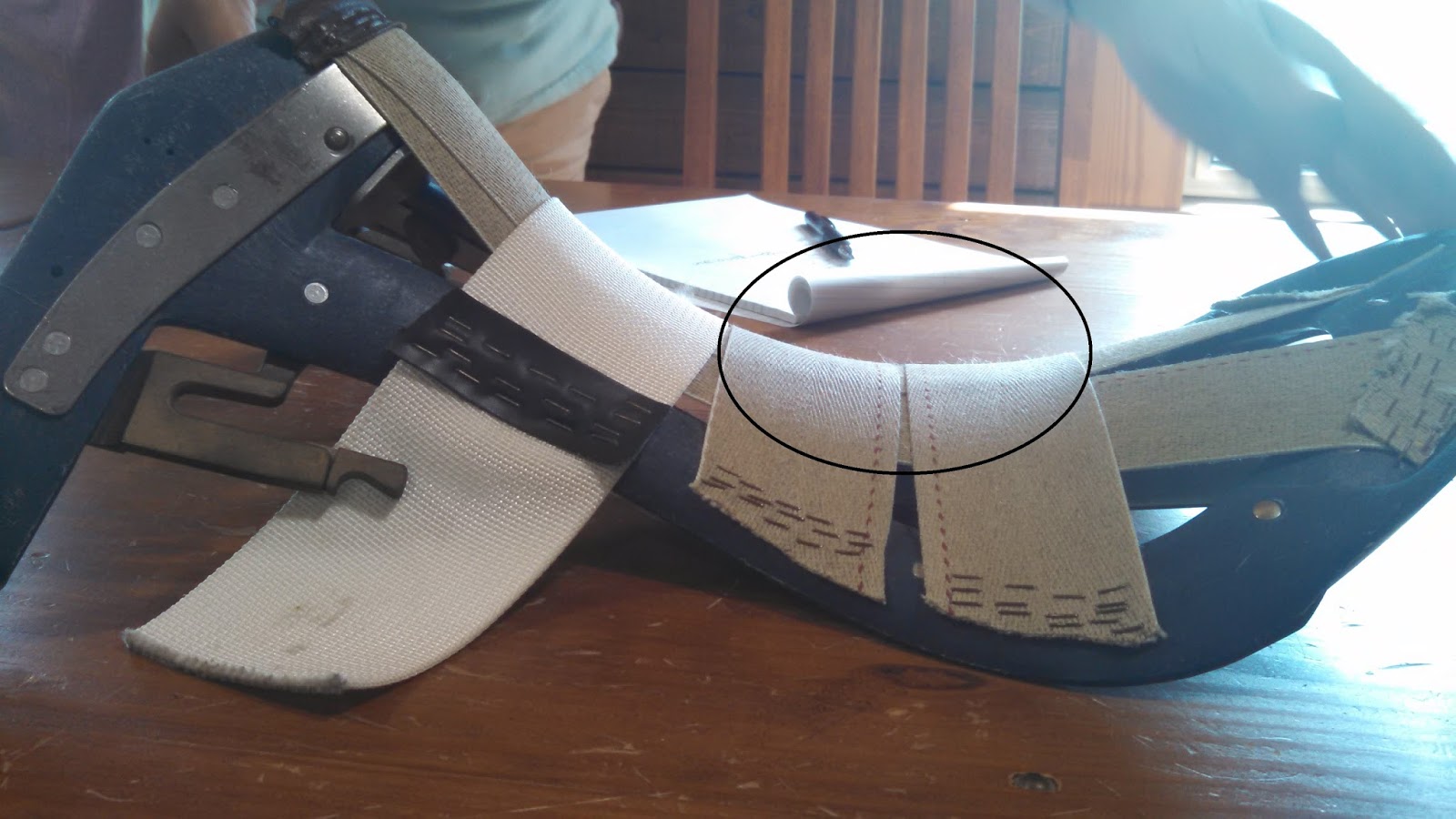
Once they have the molded composite, steel frame and variety of sizes, Stübben's next step is to tension the tree and add strapping.


To tension the tree, it is bent from pommel to cantle and strapping is strategically positioned on the frame and stapled in place. The whiter strip in the picture is used for the billets. Stability and longevity is added to the billet straps by attaching them in this manner. As depicted in the image, four main straps are used to tension the tree; two from pommel to cantle, and two across the deepest point of the seat (where the rider will ultimately sit). This allows the rider's weight to be properly absorbed by the spring of the tree as the webbing works with the steel frame. Also, once girthed down, the saddle can bend and flex with the horse's back and movement.


Once the saddle is placed on the horse and is properly balanced, the circle in the above image will become the deepest point of the seat. This is where the balance of the saddle becomes very important; a rider to far in front or behind the deepest point of the seat will not allow the saddle to distribute the weight across the horse's back.


Additionally, the cantle can move in a twisting manner, consistent with the horse's motion of his back, while staying stationary at the pommel and protecting the withers.


There are a lot of saddles out there, many will be very viable options for you and/or your horse. Some manufacturers forget that the main goal of creating this vital piece of equipment should put the horse's comfort above all else, and instead focus more on their profit margin. Stübben is strongly dedicated to designing, producing, and distributing quality products for both horse and rider where the horse comes first. After all, it's hard to stay in business for 120+ years by providing saddles and strap goods in barns across the world that don't live up to equestrian's expectations for quality equipment.